The Conradian Review
By Hugh Epstein, London
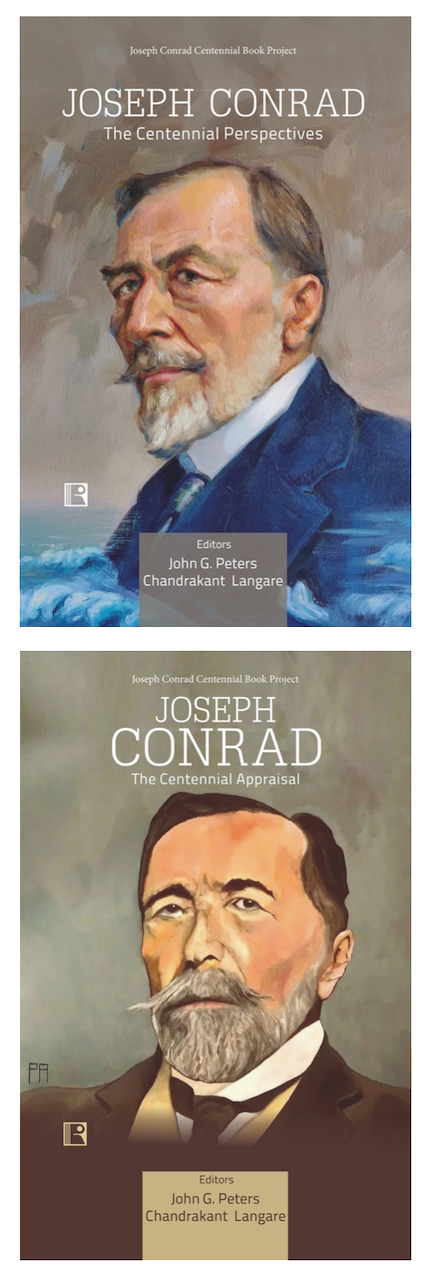
Chandrakant Langare and John G. Peters (eds.) 2 Vols.
Joseph Conrad: The Centennial Perspectives (Jaipur: Rawat Publications, 2025). 358 pp.
Joseph Conrad: The Centennial Appraisal (Jaipur: Rawat Publications, 2025). 310 pp.
As the titles of these two volumes indicate (and there is no real way to tell them apart, there is no attempt to distinguish perspectives from appraisal) the intention was for a publication that would celebrate the centenary of Conrad’s death in 1924. ‘Conrad is being rediscovered regularly’ is the optimistic claim of one contributor, and ‘research perspectives of scholars from many countries can make them mutually corrective’ writes another.
The laudable promise of these volumes is to show both of these in action, particularly in India and in the east more broadly. An opportunity to present modern readings of Conrad and his significance which are somewhat freed from the exclusive voice of western academia, and that includes the critique by Achebe which has been incorporated into it, and from the US/UK and French and Polish readings that have dominated published Conrad studies since his death, should certainly be taken. Robert Hampson in his Foreword, after alluding to the development of UK and European studies and translations of Conrad, declares that ‘the meaning of the term “Joseph Conrad” … is an acknowledgement that Conrad’s fiction has a reach beyond the little island of Britain.’
To explore that proposition the editors have assembled 43 essays and 47 contributors from 17 countries. 16 contributors are from India, 5 US, 4 Japan, 3 Algeria. 12 of the essays are updated versions of essays printed previously elsewhere or of papers given at a variety of conferences. 12 of Conrad’s works are given full essays; far more of the essays make reference to several texts and comparisons with the works of other writers or film-makers. As Hampson says, this commemoration has ‘a transnational crew of critics under international editorial management.’ Sadly, it has also to be said that the crew is not uniformly of the best and the management has not quite met the challenge of its responsibilities.
Both volumes print the Introduction by the late Jeremy Hawthorn, ‘Still Going Strong: Conrad’s Fiction a Hundred Years On’, which must be among the last pieces written by this great Conradian who has been a guiding voice and a friend to so many. It is good to have these late thoughts which, at 25 pages, provide by far the most substantial essay in the two volumes. Jeremy considers Conrad’s geographical range and how ‘cultures are to be found inside characters and their interactions’, not as exotic backdrop or location. An extensive section on ‘An Outpost of Progress’ leads him to conclude, ‘Like a person being called in as a witness of a crime who suddenly discovers that they are being interrogated as a suspect, the reader of Conrad’s fiction, led at the opening of the tale to assume that he or she is to witness and deplore the practical incompetence and ethical culpability of the two White men, suddenly finds that he or she is also in the dock.’
After a penetrating discussion of ‘pity’ in Conrad, Jeremy ends on a quotation from ‘Karain’ – ‘No man will speak to his master; but to a wanderer and a friend, to him who does not come to teach or to rule … One heart speaks – another one listens’, which elicits his closing comment, that ‘we can communicate across barriers of race, religion, social system and culture if we speak as friend to friend and not as master to servant.’
What follows is a mixed bag in every sense – in terms of approaches to literature, to specific texts and to Conrad himself; in terms of appropriate knowledge; in terms of the quality of the writing, the subtlety of insight, the reliance upon generalities or the ability to conduct convincing close reading; in terms of the state in which the contributions were delivered to the editors. There is no evident editorial standardisation and that is a pity. Whilst a variety of voice and outlook offers a diversity to be embraced, it does present the challenge apparent from any number of collections of essays – how to make a coherent book from them.
It does not seem in this case that the editors have tried to tackle this problem; rather, they have gone for a form of inclusive variety, which puts form itself in these two multiplicitous volumes, under strain. They say that ‘The book is focused on the inevitable relevance of Conradian studies in present times.’ Inevitable seems a strange word to use, and their hopes for the book to be ‘a bountiful and epistemic resource’ also points to the continuing differences of manner in the varying forms that English takes worldwide. As one of Conrad’s distinctions is his ironic awareness of just this variety, it is disappointing that there is rarely in these volumes an effort to find an equivalent modest scepticism in presenting it.
There are some accomplished essays here. The best of these is Yoko Okuda’s modest and careful close reading of the final episode in ‘The Warrior’s Soul’ in the light of ‘The Death of Atsumori’ from The Tale of the Heike, first translated into English in 1918, but possibly available to Conrad through Inazo Nitobe’s Bushido: The Soul of Japan (1900). Okuda asks us to look at the precise emotion being explored by an artist at a particular moment of a story. She explores the ‘narrative gap’ that Conrad deliberately leaves for the reader to fill in, and writes, ‘Conrad makes the reader work hard here and it is exactly the imaginative effort required of us that lifts ‘The Warrior’s Soul’ from ‘a pot-boiler’ to a tale conveying delicate emotions expressed in harsh circumstances.’
Okuda’s illumination is that what happens in ‘The Death of Atsumori’ provides the clue for what Tomassov sees and thus the meaning of the story. This small-scale study could be contrasted with Richard Ambrosini’s capacious and ambitious ‘Tragic Adventures in the Age of Empire: New and Old Laws in Lord Jim.’ For Ambrosini, Lord Jim represents Conrad’s search for a form more adequate to exploring imperialism than the adventure story: ‘This form, it will be argued, was Greek tragedy.’ Marlow’s narrative opens and closes with scenes set in courts (the Patna enquiry and the space before Doramin’s compound), ‘a ‘new’ law which provided legitimacy to the colonial powers’ sovereignty over land and sea and the ‘old’ law of traditional societies.
Between these two Ambrosini examines the scene at Stein’s, ‘the crowning achievement of an entire career.’ In an essay with much to say about Marlow, the reader is drawn towards a fundamental level of interpretation of the whole novel, whether one agrees with the claim for Greek tragedy or not.
A comparison of a different sort may be made with another essay on Lord Jim that takes Heidegger, rather than Greek tragedy, as its lens, ‘Lord Jim, Self-Understanding, and the Provocations of Reality’ by Amechi Akwanya and Mary Okolie. They write that ‘the crisis of this narrative is centred on the call of care and concern’ that should have been exercised towards the Hajj pilgrims, but which is in fact shown by Marlow to Jim in his now inauthentic existence. This largely clear and well-written essay offers numerous good insights on care and concern and ‘one of us’ – how, for instance, for Jewel and Tamb’Itam decision making returns after Jim’s death ‘as if their right of speech is restored’ – on its way to the conclusion that Jim’s error in regard to Gentleman Brown ‘leads to the sudden unconcealment of a void in what he had previously been living as a life.’ My scepticism about the value of Heidegger to an appreciation of Lord Jim was overcome.
Some other good essays that I will cite indicate the parti-coloured variety to be found in these two volumes. Jean Szczypien is clear, precise and learned in writing of the ‘Three Ghosts Haunting Conrad’s 1914 Polish Visit’, those of Apollo Korzeniowski, of Conrad himself as a father, and the father of Jułiusz Słowacki, each of whom appear in ‘Poland Revisited.’ Attending to history, particular allusions in Conrad’s writing, and interviews he gave in Polish, Szczypien’s short essay, supported by very helpful explanatory notes, acts as a reminder of what a lifelong immersion in Conrad’s Polishness can still offer even as an earlier generation of Conrad’s Polish scholars has passed away.
Robert Hampson heads away from the life and into the fiction when considering the vexed topic of ‘Conrad and Africa’, entering that relation through ‘An Outpost of Progress.’ Asking what is ‘Outpost’s’ ‘artistic purpose’, he proposes that it is not a sardonic Maupassant-like story of the disintegration of Kayerts and Carlier, but the subtler story of Henry Price, his acute understanding of what he’s dealing with, and the linguistic prowess that enables him and his wife to do so. Yu Ando, in ‘We Did Not Hear You’ lucidly explores the gains in our reading of Almayer’s Folly when we attend to the auditory rather than the visual aspects of the novel. According to Adriana Cavavero ‘hearing is always already the field for the emergence of alterity, the arrival of something unexpected.’ While Almayer shuts out voices in favour of visions (telic and nostalgic), Nina listens to the voice within herself ‘allowing her entrance into the present world of contingency.’ Yet Taminah ‘takes refuge in her imaginative and consoling soundscape’, and this solipsistic auditory imagination foretells one way that Nina’s story might continue.
In ‘Romancing Desertion: Impossible Allegiances in ‘Gaspar Ruiz’’, the late Claude Maisonnat takes on an underrated story to show that ‘the character of Gaspar Ruiz stands for that part in Conrad that was susceptible to the attacks of disloyalty’, while ‘Santierra represents that other part in Conrad that tries to come to terms with it.’ Conrad ‘romances his own predicament’ and advances the demand to examine individually the circumstances of choice, not just adherence to a code of conduct. Maisonnat concludes, ‘If its artistic qualities are not first rate, it nevertheless falls in line with the thematic concerns of Conrad’s best works.’
Other interesting and worthwhile essays, mainly by scholars well-known to readers of The Conradian, concern themselves with Chance, Victory, The Rover, ‘Youth’, and, more broadly, the Anthropocene, and the narrative trajectories that various Conrad characters find themselves a part of, though none of these decisively reconfigure (nor do they offer to) the western critiques that have dominated Conrad criticism. Nostromo and, inevitably, ‘Heart of Darkness’ encourage more assertive, less disciplined responses, though not uniformly so.
For instance, in her exploration of ‘Culturally-Mediated Perceptions’ in the novella, Xiaoling Yao makes good use of both William James and Jonathan Crary on modes of attention to the surrounding world and, seeking to go beyond Johan Warodell in her analysis of delayed decoding, she shows herself highly conversant with a range of criticism, of which she is, perhaps, just a little too careful and respectful! Baisali Hui, writing about silence and isolation in ‘Heart of Darkness’, successfully gives a descriptive character to a work in which no reference to date or season ‘makes the incidents, situations and voices of individuals float in the void, uncircumscribed by anything mundane or material’ …‘We hear the voices, but we try to understand their meaning from the silences that encompass them.’ But then she allows what would have been her own close analysis to become overwhelmed by long quotations from Watts, Sherry, Wake, Yamamoto, Acheraiou, Berthoud, Peters and Hampson. The possibility of a distinctly different ‘centennial appraisal’ stifles itself.
That possibility is more definitely asserted by Pooja Halyal and Chandrakant Langare when they discuss U-Wei Haji Saari’s film Mountain of Gold, an adaptation of Almayer’s Folly. Their ‘womanist’ critique (as opposed to feminist) of the mother-daughter relationship forcefully details how the film places Mrs Almayer, even more than Nina, as the centre of consciousness, culture and interest. While this very effectively asks the reader how we might reconsider Almayer’s Folly, there is in practice little close attention at the level of writing to Conrad’s novel itself, and only a passing mention of Chantal Akerman’s La Folie Almayer.
In his study of ‘The West, the East and the Self’ in ‘Youth’, Venkatesh Puttaiah does examine the words of Conrad’s text in the closing episode of the story, dividing his analysis into The Western Gaze, The Eastern Gaze and The Internal Gaze. While he says ‘No doubt, Conrad appears racist to us in the postcolonial era’, he claims the story ‘does not stop at the East-West dichotomy’, and on the silence of the eastern gaze writes: ‘We cannot help wondering whether the East is silent or silenced; whether Marlow has silenced the East or Conrad has silenced Marlow.’ This is an essay that is on its way to both a subtle and a challenging reading of the story, but in conclusion falls back somewhat into the more comforting ‘Conrad, thus, is the mapmaker of the East for the West.’
R. Ramachandra takes on Achebe directly in ‘A Belated Response,’ and gets down to precisely what Achebe writes in ‘An Image of Africa’ (here unaccountably renamed ‘An African Image’) and his 1990 essay ‘African Literature as Restoration of Celebration,’ and what Conrad writes in ‘Heart of Darkness.’ Sadly, an attentive discussion, largely critical of Achebe, comes completely unstuck when Ramachandra becomes fixated on taking apart Achebe’s ‘About sanity, I cannot speak’ to try to show that Conrad’s novella is ‘governed mostly by insanity.’ After a long unattributed quoted summary (it is not his own) of Marlow’s visit to the doctor, the essay fragments into a series of unconnected items recalling different episodes, a classic instance of where some timely editorial intervention and advice could have saved a promising essay from degenerating into mere notes to self.
Sadly, a similar lack of editorial oversight is prevalent throughout the essays in the collection. There are many good insights to be gleaned in a scattered way from essays that do not quite sustain themselves at the level of their best moments, yet it has also to be said that a good many fall into assertive grandiose statement at the expense of an examination of Conrad’s text. At an extreme, we find this questionable pair of statements on Nostromo: ‘Conrad has preached a very simple morality in this novel. …That is why he has been more popular than the other British novelists.’ Hirsch becomes ‘Hurst’, miners in Sons and Lovers live in ‘huts’, and Conrad features a character called ‘Captain Mcverse.’ Why do such ludicrous errors reach print uncorrected? Has there been any peer review at the beginning of the process or any proof reading at the end of it?
In an essay that has interesting things to say about Tagore, Mikulin becomes ‘Muliken’, and ‘Charlie Marlowe (sic: another essay offers us Christopher Marlow) … said “This also is the heart of darkness.”’ Elsewhere, Costaguana becomes Costa Rica; ‘a handful of dust’ in ‘The Return’ (1897) derives from The Wasteland (sic, 1922); we are treated to ‘hypothese’ – why not hypothesis?; ‘lurked’ should be lured; An Outcast of the Islands becomes The Outcast of Islands; we come across Conrad’s ‘tacit illusions’ (clearly, allusions); ‘These adjectival images of the mind of the writer strolls out of the personal space landing into the territory of culture and history’ – all these are a mere quick selection of the sorts of things that can be read on too many pages of the collection.
More generally, the level of discussion frequently is not very penetrating and can fall into the banality of ‘Writing becomes transmission of meaning, transfer of images.’ But more disturbing is the use of the term ‘savages’ by three essays without any irony and not as a quotation from Conrad, a long way from the discussion by Robert Hampson of ‘contact with pure unmitigated savagery, with primitive nature and primitive man’ which he quotes from ‘An Outpost of Progress.’ A good number of the essays here are characterised by a series of short declarative statements which in practice could have occurred in a different order. This need to be assertive and definitive afflicts several contributions at the expense of thoughtful discussion.
Seven of the essays, in my judgment, should not have reached print at all. One or two consist of a series of non-sequiturs that seem to have been assembled by AI with the intelligence turned off. In correspondence one of the editors readily described how institutional and personal medical challenges, as well as limitations in scholarship and the requirements of publishing in India, rendered the project somewhat unmanageable. The ambition and enterprise deserve notice, even though the outcome overall does showcase these difficulties somewhat obscuring the better contributions.
Not to end on a sour note, the two volumes do appear to give some sort of evidence (at least, several contributors assert it) of a popularity and an enthusiasm for reading Conrad in the Indian sub-continent that can no longer be claimed for the campuses of a disenchanted western academy, let alone for the small part of the general public that still reads serious novels. It is good for western devotees of Conrad to read, in a comparison with The Rover, about Jagiri (Satinath Bhaduri, The Vigil, 1946), ‘the first full-fledged political novel of post-Tagore Bengali modernism’, or to find that, as in ‘Heart of Darkness’, the search in Kateb Yasin’s Nedjma (1956) and Mohammed Dib’s Le Talisman (1966) is ‘a search for the right words to narrate ‘reality’, the Algerian reality during the French colonial period.’
To have read also some careful reconstruction of the readings given to Conrad by his contemporaries and early readers in India and the east, on the lines of the essays in Hampson’s recent and important The Reception of Joseph Conrad in Europe, would have been informative and illuminating in preparing the ground for a centennial appraisal (An Ning has reminded us in The Conradian of Lao She in this way; Yoko Okuda and Yasuko Shidara are working on Tadaichi Hidaka, as is Andrew Francis on G. J. Resink – each a significant non-western voice). Perhaps such writers are considered as only of historical interest with little to say to readers now.
The Centennial Perspectives/Appraisal positions itself as looking to the now and to the future. Wanting a large and visible project that gave a platform to a wide range of Conrad scholars, it is as if the editors found themselves over-extended and could not exert the requisite control over the submissions that came their way. Were it perhaps half the length and properly copy-edited, this would have been an interesting collection, even if one unlikely to achieve a tight thematic coherence.
© Hugh Epstein 2026