The Conradian Review
By Sylwia Janina Wojciechowska, Ignatianum University, Krakow
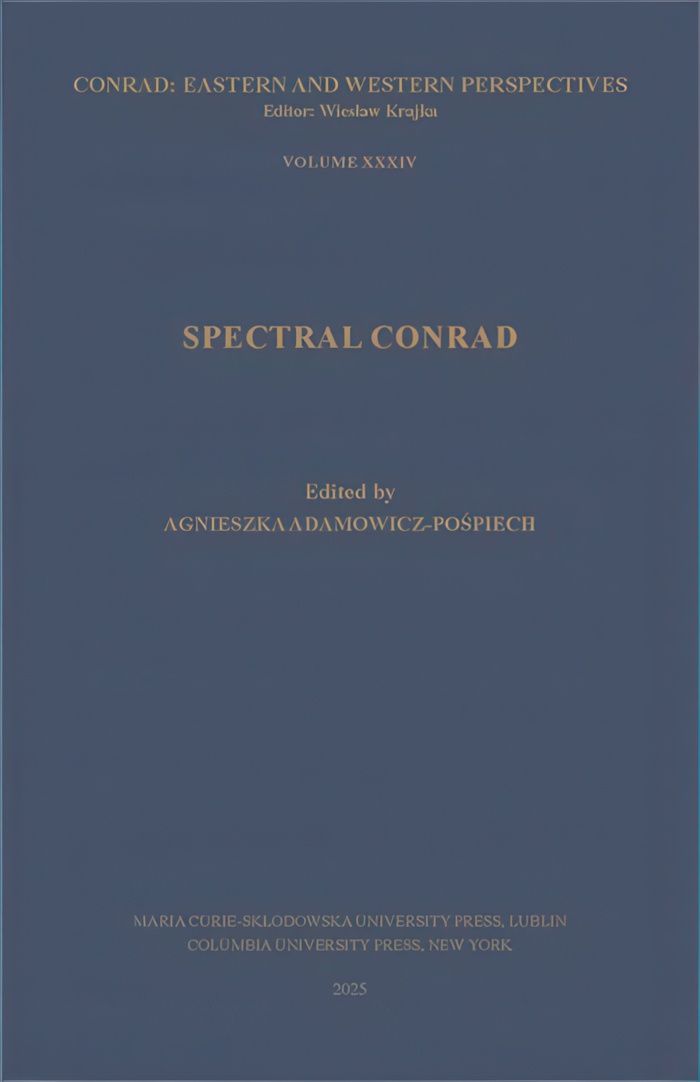
Agnieszka Adamowicz-Pośpiech (ed.) Spectral Conrad in: Conrad: Eastern and Western Perspectives vol. 34 (Lubin: Maria Curie-Sklodowska UP, 2025), vol. XXXIV, 269 pp. £68.
“In essence, Conrad’s spectral presence transcends time, leaving an enduring mark on contemporary culture,” reads the closing sentence of Volume XXXIV of “Conrad: Eastern and Western Perspectives,” the international series edited by Wiesław Krajka, which for over three decades has shaped the reception of Joseph Conrad’s legacy both in Poland and beyond. Among its thirty-four volumes, the most recent publication edited by Agnieszka Adamowicz-Pośpiech (2025) stands out for its particularly close engagement with the core of Conrad’s art, namely the persistent presence of the ineffable within works composed in and through language. The paradox is elucidated by Jan B. Gordon who, referencing Wittgenstein, argues that, there exists an invisible, and perhaps ineffable, bond underlying the visible world, a bond that links sense with non-sense, understood as “an absence of easy determination of stable referentiality” (unpublished).i By engaging with ghost-ridden spectrality and literary afterlife as discussed in the volume, Spectral Conrad approaches “the transparent body” of reality and “the beyond“ in a genuinely compelling manner.
Spectral Conrad opens with an Introduction by Agnieszka Adamowicz-Pośpiech and Jacek Mydla. The substantial opening of the publication makes it clear that spectrality as discussed by the eleven Contributors reaches out in two directions, that is into the past and the future. While the former connotes the Derridian hauntology, or, “a revisionist ontology” (3), the latter marks an unusual leap into a speculative future, which, as Jan B. Gordon observed in a private discussion, conveys “a ghostly [element] of our unfulfilled guesses and fantasies as well as mirroring reflection.” This phenomenon apparently “… troubleth [Conrad] right gretly [sic]” (Conrad 1).ii Among the range of perspectives in the volume are approaches grounded in Conrad’s biography, philosophy, and values, as well as studies of the reception and the artistic afterlife of his works. Hence, the spectral emerges as a meaningful presence in the literary discussions included in the collection.
It stands to reason that the Polish context, once haunting Conrad in exile, serves as a point of departure for a discussion upon the shadowy presence(s) in his legacy. Karol Samsel’s article, “The Legacy of Polish Dark Romanticism in Joseph Conrad’s Works,” re-approaches the issue of Conrad’s engagement with the Polish Eastern borderlandsiii by focusing upon Romanticism as developed in partitioned Poland; perhaps naturally, such political debacle called for manifestations of revolt articulated through a Romantic form and spirit. Referencing Juliusz Słowacki’s Sen srebrny Salomei [Salomea’s Silver Dream], Samsel discusses the ethical purposes underlying Conrad’s model of engagement with metaphysical and mystical writing, aesthetically embedded within the framework of late-Dark Romanticism in Poland.
The subsequent article by Jan B. Gordon, “The Trope of ‘Partitioned Sovereignties’: Shadows of Poland in Conrad,” re-directs the examination towards central Poland and political independence. “Is Poland figuratively present as yet another partitioning ‘shadow line’ in Conrad?” (57), asks the scholar. In the subsequent discussion, the dichotomy between present and absent is discussed with regard to partition as a trope applied in Conrad’s narratives. A special point of interest is Under Western Eyes which emerges as “an almost-but-not-quite-diary,” exploring ideological partitions revealed to be “false dichotomies” (61) that suggest Poland’s “continuously disrupted unity” (62).
“Concealment and Revelation in “The Warrior’s Soul” and “Prince Roman” by Laurence Davies extends the reflection on the shadowy presence(s) in Conrad’s fiction by adopting a literary-historical perspective which, to a certain extent, engages with the Polish context. Two narratives contained within the Tales of Hearsay merit particular attention: while “The Warrior’s Soul” features a shift from patriotic glory to anguish, involving a loss of all faith and courage, “Prince Roman” places a literary shadow of Prince Sanguszko centre stage. Davies compellingly argues that the featuring of the haunting exploration of conflicting armies embedded in the narratives endow the images and portraits with a surreal dimension, a dimension “underscor[ing] the surreal and otherworldly aspects of war” (90–91).
A further dimension of hauntology is uncovered in Wiesław Krajka’s chapter, “Making Magic as Cross-Cultural Encounter: The Case of Conrad’s “Karain: A Memory.” In this chapter, Krajka includes a nuanced reading of the exotic reality of the Eastern setting that essentially resonates with Eastern spectrality. The magical experience in “Karain: A Memory” is interpreted as a quasi shamanic mystery – an interpretation which proposes a new framework for Conrad’s story, thus constituting a highlight in the volume. Interestingly, the next chapter, “The Malay Forefather’s Eve – Karain: A Memory,” also addresses this particular short story. In his interpretation of the Malay narrative, Karol Samsel advances yet another approach which, instead of looking east, re-focuses upon a few traits in the story that seemingly resonate with Polish Romanticism. The dialogue between two divergent analyses of “Karain” enriches the academic discussion in the volume.
In the subsequent chapter, Cedric Watts broadens the scope of examination by focusing on the narratological rather than socio-cultural aspects in Conrad’s works. In “The Problem of the Author’s Note to The Shadow-Line,” Watts problematises the ontological clash between the common sense visible in the authorial comments preceding The Shadow-Line and the implied spectral presence of the dead Captain within the story. Conrad’s scepticism thus acquires an additional dimension that does not exclude a certain potential for the mystic within the otherwise empirically-experienced world.
The next three chapters continue to approach Conrad’s non-European narratives. While in “The Haunting Ideal in “Freya of the Seven Isles” and Nostromo,” Ellen Burton Harrington takes a closer look on women and the Gothic elements in the two texts under consideration, Remy Arab-Fuentes and Jacek Mydla rather concentrate on Lord Jim. Applying the Derridian notion of “the visor,” Arab-Fuentes engagingly discusses “the visor effect” in Lord Jim, concentrating on Jim’s inquisitive “fixed from-under stare” (165), which creates the effect redefining Conrad’s aesthetics. By contrast, Jacek Mydla reaches out to Shakespeare’s Hamlet and, juxtaposing both authors, the scholar ponders the essential presence of the dead within the spaces of what he terms the “Haunted Narratives” (183). In fact, this chapter explains how Jim “lived surrounded by deceitful ghosts, by austere shades” (183).
In his “Shadow Play in Plato’s Cave and Lord Jim,” Nic Panagopoulos delves even further back for the contexts of spectrality in Conrad’s fiction. The symbolic significance of the Cave and the vision of Hades add to the examination of the “shadowy” nature of Lord Jim (213). Panagopoulos’s engaging reading of the novel offers a convincing elaboration on the Platonic and the Conradian as “human beings are seen in the novel as unable to live completely in the real world, for Plato, the world outside the Cave” (216).
The modes of Conrad’s spectrality are finally examined by Agnieszka Adamowicz-Pośpiech who interprets the writer as a cultural figure that becomes a visible spectre, gazing out of the pages of works produced long after his death. The contribution stands out as the volume’s highlight since, perhaps somewhat unexpectedly, the writer’s literary shadow manifests himself across a series of titles significant to contemporary discourse. These are, for example, W.G. Sebald’s The Rings of Saturn or Jakub Małecki’s Dżosef. In her chapter, Adamowicz-Pośpiech explores the “spectral intertextuality” of the novelist. With her compelling discussion, the scholar demonstrates that Conrad’s spectral presence still stimulates contemporary culture.
To conclude, Spectral Conrad is a volume of outstanding scholarship, bringing into view the apparently invisible and elusive presence of the Polish-born British writer whose legacy transcends time and leaves an enduring mark on contemporary culture and literature. This collection will prove essential reading for both seasoned Conradians and readers intrigued by the hidden and the spectral in literary masterpieces.
© Sylwia Janina Wojciechowska 2026
References
Bremer, Józef. „Franz Rosenzweig i Ludwig Wittgenstein o milczeniu” [Franz Rosenzweig and Ludwig Wittgenstein on Silence]. In: Troska i odpowiedzialność. Prace dedykowane doktorowi Adamowi Żakowi SJ z okazji 75-lecia urodzin. Ed. by K. Biel, J. Poznański, A. Seredyńska, Kraków: Wydawnictwo Naukowe UIK, 2026, pp. 209–229.
Conrad, Joseph. The Mirror of the Sea. Memories and Impressions. A Personal Record: Some Reminiscences. Dent and Sons, 1968.
Krajka, Wiesław. Joseph Conrad. Kresowy i uniwersalny. Amy Foster. Lublin: Wydawnictwo UMCS, 2020.
Wittgenstein, Ludwig. 1922. Tractatus Logico-Philosophicus. Translated by Charles Kay Ogden. London: Kegan Paul, Trench, Trubner.
Wojciechowska, Sylwia Janina. “Consolatio naturae in Joseph Conrad’s The Mirror of the Sea.” Consolations of Nature. Human–Nature Relations in Modern and Contemporary Anglophone Literature. Ed. by Šárka Bubiková, Bożena Kucała, and Beata Piątek. Leiden, Boston: Brill, pp. 25–37.
iA discussion on the “transparent body” in May 2025 (the author’s private correspondence). On ineffability, see Wittgenstein’s Tractatus Logico-Philosophicus. I extend my gratitude to prof. Józef Bremer, a Wittgensteinian scholar, who introduced me into Wittgenstein’s logic of silence.
iiOn the meaning of the Latin miraculum, see my: “Consolatio naturae in Joseph Conrad’s The Mirror of the Sea,” 2025, pp. 28–29.
iiiCf. Wiesław Krajka, Joseph Conrad. Kresowy i uniwersalny. Amy Foster. 2020.