The Conradian Review
By Tamás Juhász, Károli Gáspár, University of the Reformed Church, Hungary.
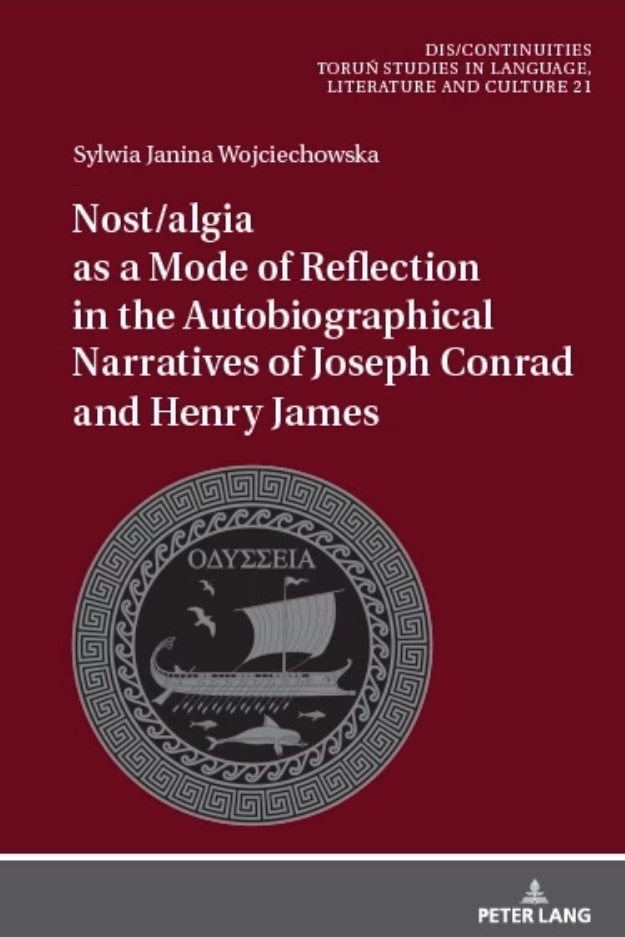
Sylwia Janina Wojciechowska. Nost/algia as a Mode of Reflection in the Autobiographical Narratives of Joseph Conrad and Henry James (Peter Lang, 2023). 244 pp.
The straightforward title of this book quickly identifies an interesting and underexplored thematic focus. It promises to elucidate, in a philologically oriented, linguistically aware manner, the key concept of nostalgia (purposefully typeset as “Nost/algia” to deconstruct received notions of the emotion and express the need for systematic, and historically precise, reengagement not only with the ideas of “return” and “pain”, but their intriguing embeddedness into each other). It also promises to place this exploration in the context of autobiographical writing, signalling thereby an interest in such phenomena as self-construction, self-representation, retrospection, performativity, temporal layering or negotiations between the public and the private selves.
And it indicates that it is within the broader framework of late nineteenth- and early twentieth-century literature that this critical investigation will be carried out, pointing to the fascinating tensions that modernist cultural regimes often displayed between anxious celebrations of the new and melancholic musings over what has been lost.
The multiple promises implicit in the title (and indeed, Lejeune’s notion of an authorial contract with the reader is evoked in the book) are fully fulfilled. A long, ambitiously structured introduction opens and explains the somewhat unusual structure of the treatise (only a ten-page long section is actually labelled as introduction, but another two thirty-page chapters still strike the reader as essentially introductory in that they precede, and create a historical and theoretical foundation for, the upcoming, closer readings of Conrad and James). In addition, it clarifies the difference between modes of “simple” and “complex” nostalgia – a key distinction that will serve as a frequently deployed, useful theoretical tool throughout Wojciechowska’s project.
But this binary is only one of the many systems of classifications in which the author places nostalgia, diachronically and then increasingly synchronically, for exploration. We learn, among other things, that while simple nostalgia as longing (for example as home-sickness) is detectable already in Greek and Roman antiquity, complex, historically and dialogically oriented modes of nostalgia (less concerned with return to a given place than with the desire to arrest the passing of time and revisit the past) arise only towards the end of the 17th century (to be viewed, initially at least, as a medical condition). A wide array of theoretical perspectives, together with extensive cultural and literary historical commentaries on time, space and longing in modernity inform the book.
After this substantial mapping of the concept, phenomenon and emotion known as nostalgia, thorough readings of Conrad and James follow, once again in three sections: “Bios”, “Auto” and “Graphe.” Additional explanatory words complete these subtitles (so the first unit reads as “Bios: The world reference”) and the very choice of ancient Greek terms (with all their attention-getting, defamiliarizing effects) confirms (once again) the impression that the entire book will be almost radically historically oriented, language and tradition-conscious (the author’s solid background in classical philology is very much detectable in the process).
But while this indeed turns out to be the case, Wojciechowska’s attunement to the past (as history, as literary-cultural convention, or as the representation of a particular, bygone stage in life) never makes the reader question the continuing relevance of the studied literary materials and their myriad contexts. On one level, this sense of relevance for our time in late modernity is achieved by the productive conceptualization of nostalgia, where the central engagement with things past combines smoothly and favourably with intriguing insights from recent and contemporary theory. On another level, writing about nostalgia felt and articulated around the 1900s is rendered our concern by the mere readability of the book: despite its heavily annotated character, its language and general composition remain flowing, at once elegant and reader-friendly.
The first of these chapters (Bios) tackles the problem of referentiality in life writing, the second (Autos: (Up)rootedness and the self) explores how memories of homelands are retrieved, and the third (Graphe: Writing oneself) investigates the nostalgic impulse through narrative language, linguistic-stylistic strategies, choices and uses of particular imageries. Thus, in the Conradian section of Bios, we learn mainly about The Mirror of the Sea and its portrayal of a difficult transition from sailing ships to steam-powered ships, enabling the writer to engage, instead of potentially escapist, simple nostalgia, in the complex version of the emotion which “helps in critically approaching the present moment through a nostalgic elaboration of the past” (91).
In the Henry James part of the same chapter – where, as in the other chapters, the so-called Autobiographies (containing such publications as A Small Boy and Others, Notes of a Son and Brother, and the unfinished The Middle Years) is treated – we can read about the author’s impartial, essentially observant attitude towards historical change, his signature contrasts between European and American cities at their various, respective stages of urban development, and his narrative renditions of intersections of individual and collective memories about transformative historical watersheds, especially the American Civil War.
Autos continues to discuss reflections on the two authors’ attitudes to the past but with specific focus on home spaces, and the varied conceptualizations of the very idea of home: as elsewhere in the book, a sophisticated, linguistic historically informed approach is at work, creating, for example, productive semantic and cultural distinctions between such terms as “patris”, “patria”, “heim” and “home” (appearing in Barbara Cassin’s Dictionary of Untranslatables, “patris”, the Greek conveyor of the fact that the homeland belongs to the father, will be distinguished among these).
Wojciechowska first turns to Conrad’s A Personal Record (which she reads as a sort of sequel to the Mirror of the Sea) and, as a central thought in her argument, discusses the publicly, rather than privately oriented, articulations of belonging. For her, “the narrative [is] an exploration of the variety within ‘Polish life’ – multicultural, multiethnic, rich in traditions and with great patriotic feelings – [with] clearly visible nostalgia in the text … involv[ing] the individual without … revealing the individual’s most intimate thoughts and emotions” (119). This individual – the reminiscing persona in A Personal Record – is also a modern-day Odysseus-figure in Wojciechowska’s reading, who (corresponding, in certain ways, to the limited stay Homer’s hero could enjoy in the coda of Odessey) cannot fully complete an act of nostos: “If the confines of Conrad’s intimate patris may be avoided for private reasons, the national image of patria, reverentially but not uncritically painted, essentializes a home which, due to its being rooted in the past, cannot ever be revisited” (136).
The Jamesian narratives of homecoming also have their classical reference: following an insightful comparison with Conrad’s Homeric allusions, the Virgilian hero Aeneas is argued, in this section, to focalize key cultural continuities, concerns and anxieties about the possibilities of return. For the author, this version of nostos constitutes arrival in a new, future construct of home, a sphere that Barbara Cassim (a theorist whom Wojciechowska often references) expressively calls “the future anterior” (141). In it, memories of James’s American past merge with the memories of his forefathers about Europe and Britain, but at the same time, these sets of European imageries are also the home spaces where the cosmopolitan novelist, with his inquisitive, forward-looking cultural attitude is in the process of entering.
Finally, Graphe approaches the presence of nostalgia in life writing from a generic, narratologically oriented manner. But this scope of critical investigation never remains purely formalistic; instead, it explores modes, techniques and conventions of writing in their deep embeddedness into larger civilizational contexts. Thus, in the first section of the chapter, the author studies the presence of the so-called gawęda – “a specific literary genre and also […] a form of speech established within the culture of the Polish borderlands” (160) – in A Personal Record and the essays “Poland Revisited” and “First News” from Notes on Life and Letters.
So while complex readings offered by Wojciechowska involve a large number of topics (including, for example, the partitioning of Poland, the outbreak of World War I, or urban experiences in Cracow), it is their couching in the implied speaker’s rhythms, intonations, even silences, that Conrad’s emotional attitudes towards these events and phenomena unfold.
The final subchapter of the book sees again an interesting blend of generic perspectives and a number of privileged themes in Henry James. Perspective here is meant in a quite literal sense, as Wojciechowska focuses on visual imageries in Jamesian autobiographical writing, how the novelist’s interest in literary portraits combines with the narrative featuring of such visual artefacts as, for example, the daguerreotype. Visuality becomes, in this reading, an adequate medium to enable the cognitive distinction between the young and the old, the past and the present, both on the level of human individuals and the histories of America and England.
Of particular note in the analysis is James’s pastoral vision and discourse, with its interest in the notion of the home and the “cultural symbol of America as a virgin country” (181). Here, as elsewhere in this otherwise so multilayered book, the sweet and bitter fluctuations of nostalgia, as felt in the wake of these modulating temporalities, remain the core objects of the argumentation. One finishes this book with the sense that nothing essential could have been added to this nuanced treatment of a distinctly modern and complex human emotion within its clearly demarcated lines of inquiry: Conrad, James, and their autobiographical writings.
Reflecting, however, less on the execution of this valuable and relevant scholarly project than on how a similar but differently conceived study might have unfolded may leave the reader with the feeling of wanting more. The reasons why Conrad and James can be read together are convincingly explained, but perhaps a larger study on the theme of nostalgia in the English-language fiction of the first half of the twentieth-century (potentially including, among others, Beckett, Jean Rhys, Fitzgerald, or the younger, yet-to-be translated Nabokov) could have appealed to a larger readership.
Another, slimmer alternative to the present, relatively long yet very focused project could have been discussing Conrad only, but with reference extended to nostalgia as a persistent motif in Conradian fiction, too. But these are just ruminations about scholarly options, and about the fascinating richness of early twentieth century literary writing, triggered not by a sense of something missing in this treatise, but by the impression that what has been aimed at has been achieved so well. Marked by exemplary research, Sylwia Wojciechowska’s monograph constitutes a valuable contribution to scholarship on the autobiographical writings of Conrad and James, as well as to the broader field of modernist studies.
© 2026 Tamás Juhász